Devoir de synthèse n°1 English Baccalauréat | 3 sujets PDF
DEVOIR DE SYNTHÈSE N°1 · BACCALAURÉAT (4TH FORM)
Overview of the end-of-term English test
The Devoir de synthèse n°1 in English closes the first term of the Baccalauréat (4th Form). Lasting two hours and marked out of 20 (coefficient 2), it assesses the whole term’s work across three parts: Reading Comprehension, Language, and Writing.
This page brings together three complete exams covering Science & Technology, Education, and Youth & Travel, complete with figures and PDF answer keys.
Baccalauréat (4th Form)Marked out of 20Duration: 2 hoursPDF answer keys included
Part
Content
Marks
Reading Comprehension
Adapted article (300–400 words), title/main idea, true/false with justification, gap-fill, reference words, synonyms, open questions, and chart reading.
8 pts
Language
Vocabulary gap-fill with one extra word, verb tenses/forms, and circling the correct alternative (relatives, linkers, prepositions, phrasal verbs).
6 pts
Writing
Guided biography (6–8 lines) from chronological notes and an opinion essay or informal letter (10–12 lines).
6 pts
Total
20 pts
OFFICIAL SYLLABUS · FIRST TERM
Key skills and themes assessed
Reading & themes: solar power in rural villages (Science & Technology), banning smartphones at school (Education), and volunteering abroad (Youth & Travel), with justification, inference, and chart interpretation.
Language & writing: Past Simple, Present Perfect, Past Continuous, Second Conditional, Reported Speech, Passive/Subjunctive, guided biographies, opinion articles, and informal letters.
SYNTHESIS SELECTION
The three exclusive exams
Bac English — Solar power lights up African villages
Exam 01
Rural solar mini-grids in Cameroon, electrification chart, tenses, biography of Sarra Ben Ammar, and technology essay.
EXAM 01 · Bac English — Solar power lights up African villages
Exam 01
Exam 01 — Bac English (4th Form): Solar power lights up African villages (20 pts · 2 h).
EXAM PAPER — 20 marks
Part One — Reading Comprehension (8 marks)
Read the following text carefully, then answer the questions below.
SOLAR POWER LIGHTS UP AFRICAN VILLAGES
[1] For decades, the village of Mokolo, in northern Cameroon, lived in darkness as soon as the sun set. Children did their homework by the flickering light of kerosene lamps, which filled the room with toxic smoke and cost poor families more than a tenth of their monthly income. Clinics could not refrigerate vaccines, and businesses had to close at dusk. Today, thanks to a solar mini-grid installed by a local start-up, Mokolo has electricity twenty-four hours a day, and life has changed beyond recognition.
[2] Across sub-Saharan Africa, more than 600 million people still lack access to reliable electricity. Governments have struggled for years to extend the national grid to remote communities, but the cost of laying power lines across vast distances is simply too high. Solar energy has emerged as the most practical solution: it is clean, renewable, and increasingly affordable. The price of solar panels has dropped by nearly 80% over the past decade, making small-scale projects financially viable even in the poorest regions.
[3] The impact on education has been remarkable. In villages where solar power was introduced, school enrolment has risen sharply, and teachers report that pupils are more attentive in class. ‘My children can now study in the evening without damaging their eyes,’ said Aminata, a mother of four. ‘They can also use a computer for the first time.’ Several schools have received laptops and projectors, allowing pupils to connect to the internet and access educational resources that were previously out of reach.
[4] Despite these successes, challenges remain. Many solar systems break down because there are no trained technicians nearby to repair them. Funding is still scarce, and some governments are slow to support local entrepreneurs. Experts insist that training young people to maintain the equipment is just as important as installing it. ‘A solar panel that nobody can fix is useless,’ warned one engineer. The goal now is to make these projects sustainable so that the lights stay on for generations to come.
(Adapted from BBC News and The Guardian, 2024)
─── COMPREHENSION QUESTIONS ───
1) Tick (√) the best title for the passage. (1 mark)
A) The High Cost of Solar Panels in Africa
B) Solar Energy Transforms Life in African Villages
C) Why Governments Fail to Extend the Power Grid
2) Say whether the following statements are True or False, then justify with a detail from the text. (4 marks)
a) Kerosene lamps were cheap and safe for families in Mokolo. (§1)
b) The cost of extending the national grid to remote areas is very high. (§2)
c) Solar power had no effect on school attendance. (§3)
d) All solar systems work perfectly and never break down. (§4)
3) Complete the following sentence with words from the text. (2 marks)
Solar energy is a practical solution because it is clean, …………………. and increasingly …………………. . Moreover, the price of solar panels has …………………. by nearly 80% over the past decade.
4) What do the underlined words in the text refer to? (2 marks)
a) which (§1) refers to ………………………………
b) it (§4) refers to ………………………………
5) Find in the text words that are closest in meaning to: (2 marks)
a) toxic (§1) ≈ ………………………………
b) scarce (§4) ≈ ………………………………
6) Answer the following question. (2 marks)
According to the engineer (§4), why is it important to train young people to maintain solar equipment?
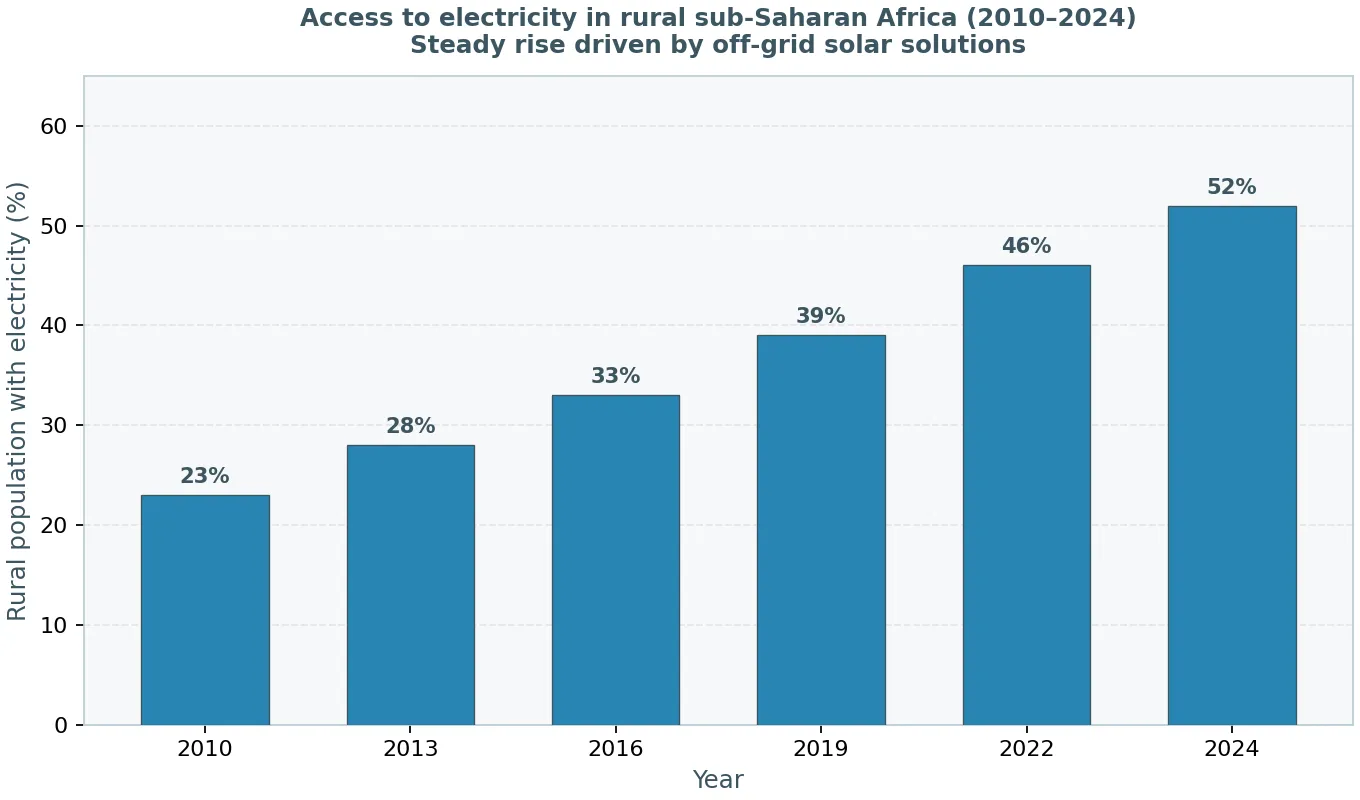
7) Look at Figure 1 and identify the general trend in rural electrification in sub-Saharan Africa between 2010 and 2024. (1 mark)
Figure 1 — Access to electricity in rural sub-Saharan Africa (percentage of the rural population, 2010–2024).
Part Two — Language (6 marks)
1) Fill in the blanks with words from the box. There is ONE extra word. (2.5 marks)
[ renewable — installed — afford — dropped — maintained — connect ]
Solar mini-grids are a …………… source of energy that can be …………… in remote villages. Thanks to the falling price of panels, even poor families can now …………… electricity. Pupils can …………… to the internet and access educational resources. However, the equipment must be properly …………… to remain useful.
2) Put the verbs in brackets in the correct tense or form. (2 marks)
a) Before the solar grid was installed, the children (study) …………… by the light of kerosene lamps.
b) Solar energy (become) …………… the most practical solution for remote villages over the past decade.
c) If governments (support) …………… local entrepreneurs, more villages would have electricity today.
d) The engineer insisted that young people (train) …………… to repair the equipment.
3) Circle the correct alternative. (1.5 marks)
Renewable energy is a solution (which / who / whose) can transform poor communities. (Although / Despite / Because of) the high initial cost, solar power pays (off / out / up) in the long term. It is both clean (and / or / but) affordable.
Part Three — Writing (6 marks)
1) Guided writing — Biography (2.5 marks)
Use the notes below to write a short biography (about 6–8 lines) of the Tunisian solar-energy engineer Sarra Ben Ammar.
• 1985: born in Sfax, Tunisia / showed an early interest in science.
• 2003: entered the National Engineering School of Sfax.
• 2008: graduated as an electrical engineer / won a scholarship to Germany.
• 2012: obtained a PhD in renewable energy in Munich.
• 2015: returned to Tunisia / founded ‘Soleil Pour Tous’, a start-up installing solar mini-grids in rural villages.
• 2023: received the African Innovation Award / has already brought electricity to more than 50 villages.
Sarra Ben Ammar was born in Sfax, Tunisia, in 1985. …………………
2) Essay (3.5 marks)
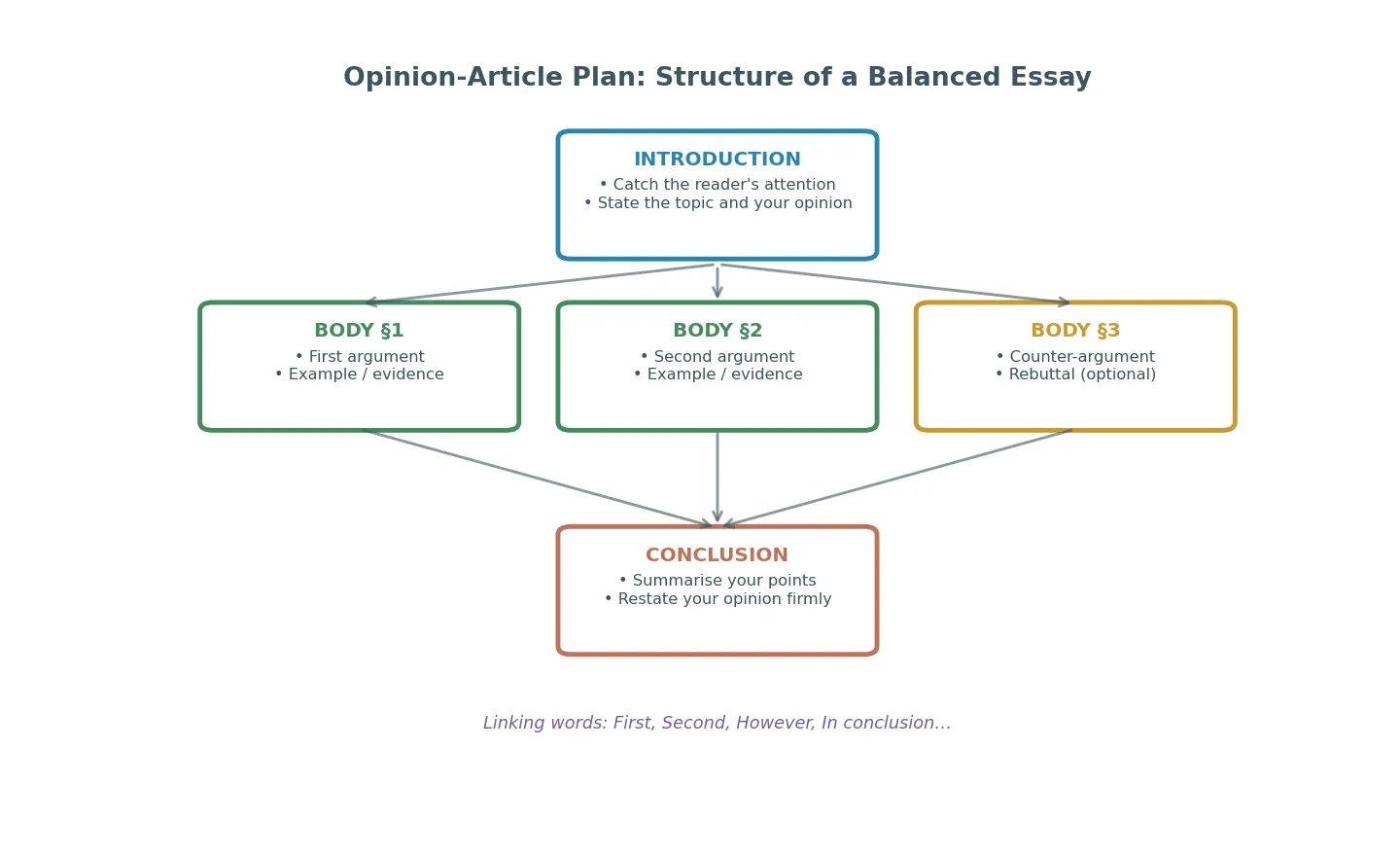
You recently read an article claiming that ‘technology is widening the gap between rich and poor rather than closing it.’ Write an article for your school magazine in which you express your own opinion and defend it with strong arguments. Give examples to support your view. (Write about 10–12 lines.)
Figure 2 — Opinion-article plan: structure of a balanced essay.
EXAM 02 · Bac English — The school that banned smartphones
Exam 02
Exam 02 — Bac English (4th Form): The school that banned smartphones (20 pts · 2 h).
EXAM PAPER — 20 marks
Part One — Reading Comprehension (8 marks)
Read the following text carefully, then answer the questions below.
THE SCHOOL THAT BANNED SMARTPHONES
[1] When the headmaster of Riverside Secondary School announced, in September 2023, that smartphones would be banned on school premises from January 2024, both pupils and parents protested loudly. ‘How will my daughter contact me after school?’ asked one father. ‘This is a violation of our freedom!’ declared a group of teenagers. Six months later, however, the same parents and pupils admit that the decision was one of the best the school has ever made.
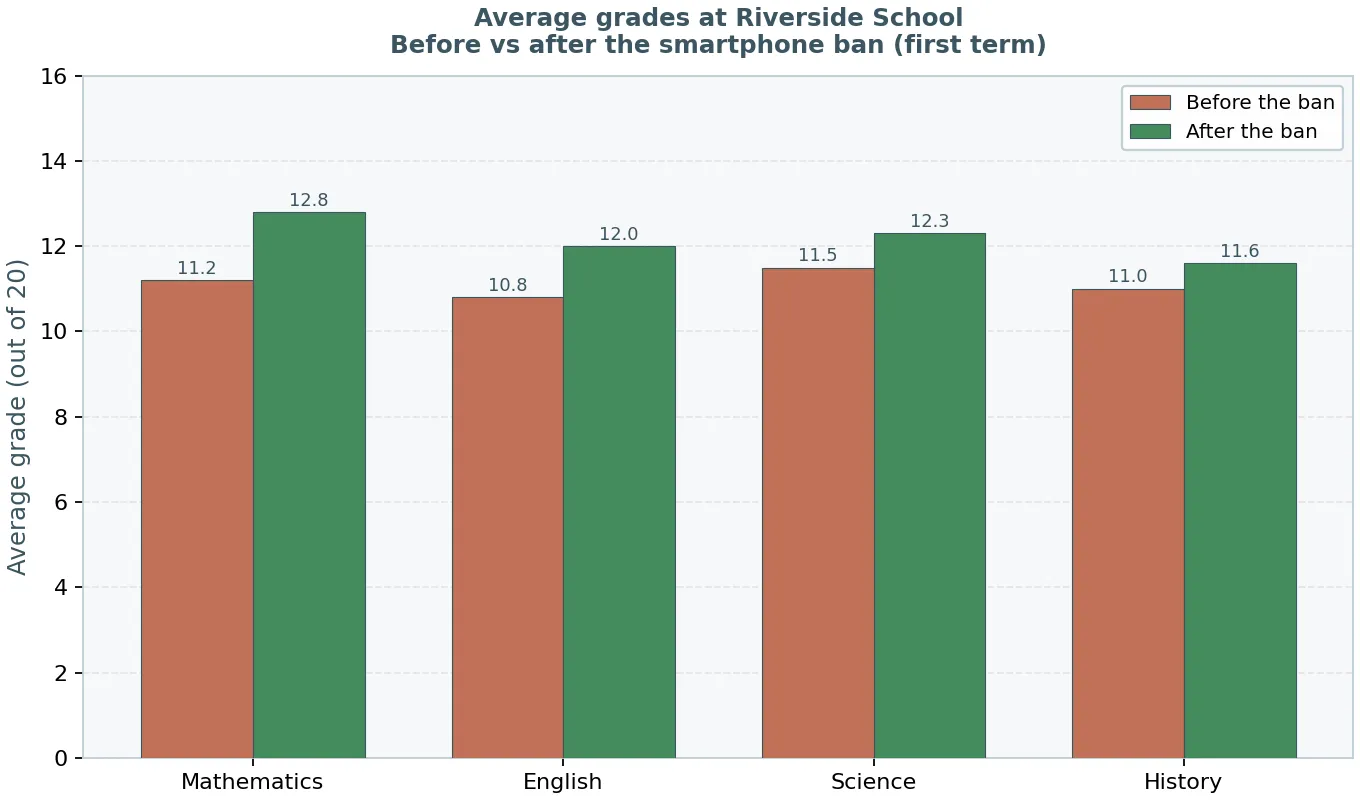
[2] The results have been striking. According to a report published by the school, pupils’ average grades in Mathematics rose by 14% and in English by 11% during the first term of the ban. Teachers noticed that students were more focused in class and participated more actively in discussions. Discipline problems, which used to disrupt lessons daily, dropped by nearly half. ‘For the first time in years, I can teach without competing with TikTok,’ said Mrs Robinson, an English teacher.
[3] The social benefits were equally impressive. At break time, the schoolyard is now full of pupils talking, playing football, or reading instead of staring silently at their screens. ‘I have made more friends in three months than in the whole of last year,’ said Liam, a fifteen-year-old pupil. School counsellors report that cases of cyberbullying, which had become a serious concern, have almost disappeared. Pupils also sleep better at night because they no longer stay up scrolling through social media.
[4] Not everyone is convinced. Some parents argue that teenagers must learn to use technology responsibly rather than being shielded from it. Others point out that smartphones can be useful educational tools when used properly. The headmaster replies that the ban does not reject technology — the school has equipped every classroom with tablets and computers — but simply removes the main source of distraction. ‘We are not against technology,’ he said. ‘We are for education.’
[5] The success of Riverside has inspired several other schools to consider similar measures. Whether the ban will be adopted nationwide remains an open question, but one thing is certain: a small decision has changed the atmosphere of an entire school.
(Adapted from The Times Educational Supplement, 2024)
─── COMPREHENSION QUESTIONS ───
1) Tick (√) the sentence that best states the main idea of the text. (1 mark)
A) Smartphones are useful educational tools that should never be banned.
B) Banning smartphones at school has improved both grades and social life.
C) Parents and pupils were right to protest against the headmaster’s decision.
2) Read and complete the following table with information from the text. (3 marks)
Aspect of school life | Before the ban | After the ban
Average grades | …………… | ……………
Discipline problems | …………… | ……………
Behaviour at break | …………… | ……………
Cyberbullying | …………… | ……………
3) Say whether the following statements are True or False. Justify with a detail from the text. (4 marks)
a) When the ban was announced, everybody agreed immediately. (§1)
b) Mrs Robinson could finally teach without competing with social media. (§2)
c) The ban completely removed all technology from the school. (§4)
d) Other schools are interested in copying Riverside’s decision. (§5)
4) What do the underlined words in the text refer to? (2 marks)
a) the same (§1) refers to ………………………………
b) which (§2) refers to ………………………………
5) Find in the text words that are closest in meaning to: (2 marks)
a) striking (§2) ≈ ………………………………
b) convinced (§4) ≈ ………………………………
6) Answer the following question in your own words. (2 marks)
How does the headmaster (§4) justify the fact that the school still uses tablets and computers despite the smartphone ban?
Figure 1 — Average grades at Riverside School before and after the smartphone ban (out of 20).
Part Two — Language (6 marks)
1) Fill in the blanks with words from the box. There is ONE extra word. (2.5 marks)
[ focused — distraction — grades — scrolling — convinced — banned ]
Since smartphones were ……………, pupils have become more …………… in class and their …………… have improved. Instead of …………… through social media at break time, they now talk and play together. Even the most sceptical parents are now …………… that the decision was a good one.
2) Put the verbs in brackets in the correct tense or form. (2 marks)
a) When the headmaster (announce) …………… the ban last September, many parents protested.
b) Since the ban was introduced, pupils’ grades (rise) …………… significantly.
c) If every school (adopt) …………… such a measure, discipline would improve nationwide.
d) The headmaster said that smartphones (be) …………… the main source of distraction.
3) Circle the correct alternative. (1.5 marks)
Pupils (who / which / whose) stare at their screens all day become (less / fewer / least) sociable. (Although / Because / Despite) smartphones can be useful, they often turn (into / out / off) a major distraction. The headmaster insists (in / on / at) removing them to protect the pupils’ concentration.
Part Three — Writing (6 marks)
1) Guided writing — Biography (2.5 marks)
Use the notes below to write a short biography (about 6–8 lines) of the British educator Charlotte Evans.
• 1970: born in Manchester, England / passionate about literature.
• 1988: studied English Literature at Cambridge University.
• 1992: became a secondary-school English teacher.
• 2010: published ‘Teaching in the Digital Age’, a book on technology and education.
• 2018: appointed headmistress of Riverside Secondary School.
• 2024: banned smartphones on school premises / improved grades and discipline / inspired many other schools.
Charlotte Evans was born in Manchester, England, in 1970. …………………
2) Essay (3.5 marks)
Your school is considering banning smartphones on school premises. Write an article for the school magazine in which you give your opinion on this decision. Argue for or against the ban and support your position with at least two arguments and examples. (Write about 10–12 lines.)
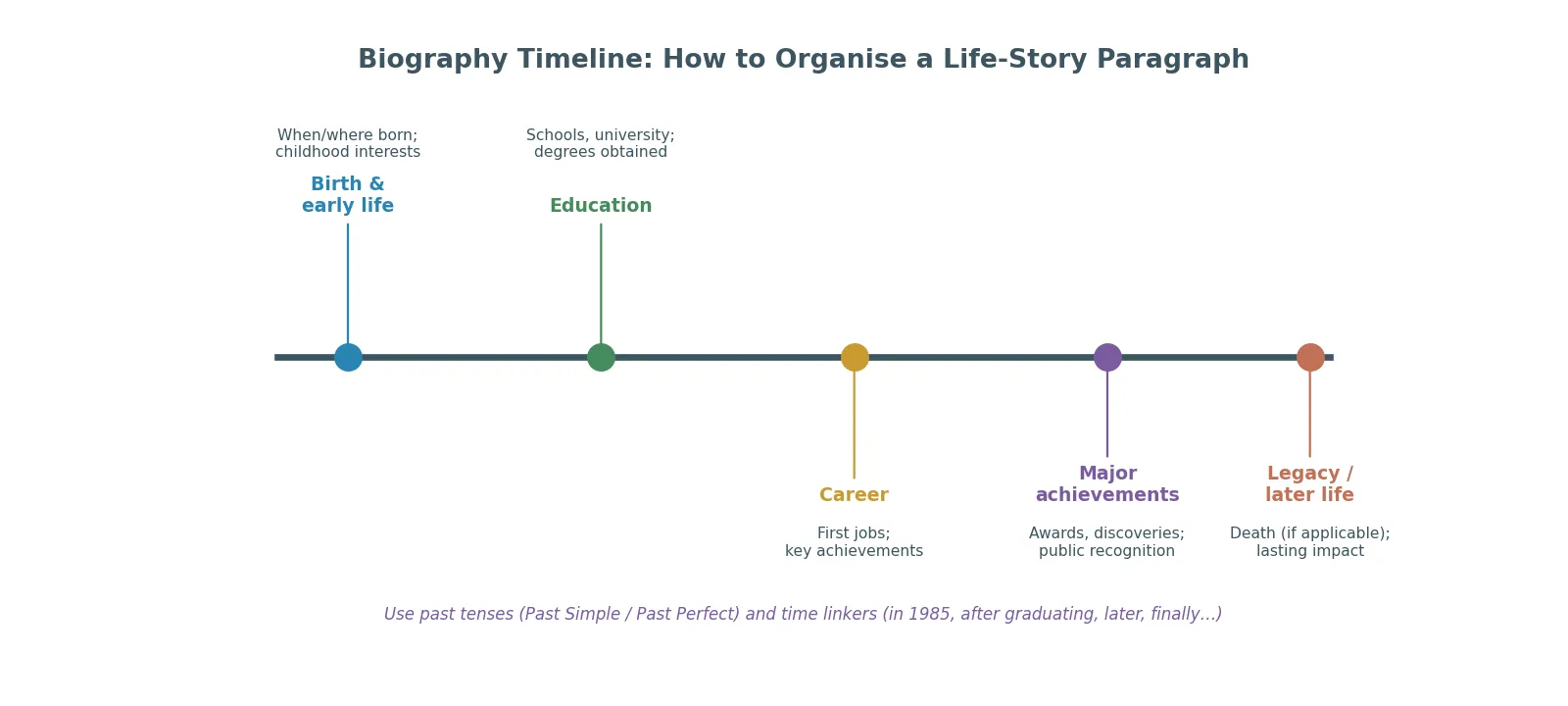
Figure 2 — Biography timeline: how to organise a life-story paragraph chronologically.
EXAM 03 · Bac English — A volunteer’s journey in Tanzania
Exam 03
Exam 03 — Bac English (4th Form): A volunteer’s journey in Tanzania (20 pts · 2 h).
EXAM PAPER — 20 marks
Part One — Reading Comprehension (8 marks)
Read the following text carefully, then answer the questions below.
A VOLUNTEER’S JOURNEY IN TANZANIA
[1] When eighteen-year-old Yassine, a Tunisian high-school graduate, signed up for a three-month volunteer programme in Tanzania, he had no idea how much the experience would change him. ‘I wanted to do something useful before starting university,’ he explained. ‘I also wanted to discover another culture.’ Arriving in the small village of Maji Moto, at the foot of Mount Kilimanjaro, Yassine felt both excited and anxious. He could not speak a word of Swahili, and the simple house where he was to live had neither running water nor electricity.
[2] His main task was to teach English and mathematics to primary-school children. The school was poor — there were not enough books, and forty pupils shared a single classroom — but the children were eager to learn. ‘Their enthusiasm was incredible,’ Yassine recalls. ‘Even without materials, they listened carefully and asked endless questions.’ He soon realised that his role was not only to teach academic skills but also to share his culture and learn from theirs.
[3] Life in Maji Moto was difficult but rewarding. Every morning, Yassine woke up at five to fetch water from the well, two kilometres away. In the evening, he sat around the fire with the villagers, who taught him their songs and traditions. The most challenging moment was homesickness. ‘There were nights when I wanted to give up and fly home,’ he admitted. ‘But every time I saw the children’s smiles, I found the courage to stay.’
[4] The programme changed Yassine’s view of the world and of himself. He discovered that happiness does not depend on material comfort. He learned patience, humility and resilience. Above all, he understood that helping others is one of the most fulfilling things a young person can do. ‘I went to Tanzania thinking I was giving something,’ he said. ‘I came back realising I had received much more than I gave.’
[5] Today, Yassine is studying medicine at the University of Tunis. He intends to return to Tanzania after graduation to work as a doctor in a rural clinic. His experience has inspired several of his classmates to volunteer abroad. ‘Volunteering is not a sacrifice,’ he concludes. ‘It is an adventure that shapes who you become.’
(Adapted from The Washington Post and Jeune Afrique, 2024)
─── COMPREHENSION QUESTIONS ───
1) Choose a suitable title for each paragraph. (2 marks)
Titles: [A) A life-changing decision] [B) Back home and looking ahead] [C) Teaching in a poor school] [D) Hardship, homesickness and courage] [E) What Yassine learned about himself]
Paragraph 1 → ………… Paragraph 2 → ………… Paragraph 3 → ………… Paragraph 4 → ………… Paragraph 5 → …………
2) Say whether the following statements are True or False. Justify with a detail from the text. (4 marks)
a) Yassine could speak Swahili fluently when he arrived. (§1)
b) The children in Maji Moto were not interested in learning. (§2)
c) Yassine never felt like giving up during his stay. (§3)
d) Yassine plans to return to Tanzania after his studies. (§5)
3) Complete the following paragraph with words from the text. (2 marks)
Yassine’s main task was to …………… English and mathematics to primary-school children. Every morning, he had to fetch …………… from a well two kilometres away. He discovered that happiness does not depend on …………… comfort, and that helping others is one of the most …………… things a young person can do.
4) What do the underlined words in the text refer to? (2 marks)
a) their (§2) refers to ………………………………
b) who (§3) refers to ………………………………
5) Find in the text words that are closest in meaning to: (2 marks)
a) eager (§2) ≈ ………………………………
b) fulfilling (§4) ≈ ………………………………
6) Answer the following question in your own words. (2 marks)
What did Yassine mean when he said (§4): ‘I went to Tanzania thinking I was giving something. I came back realising I had received much more than I gave’?
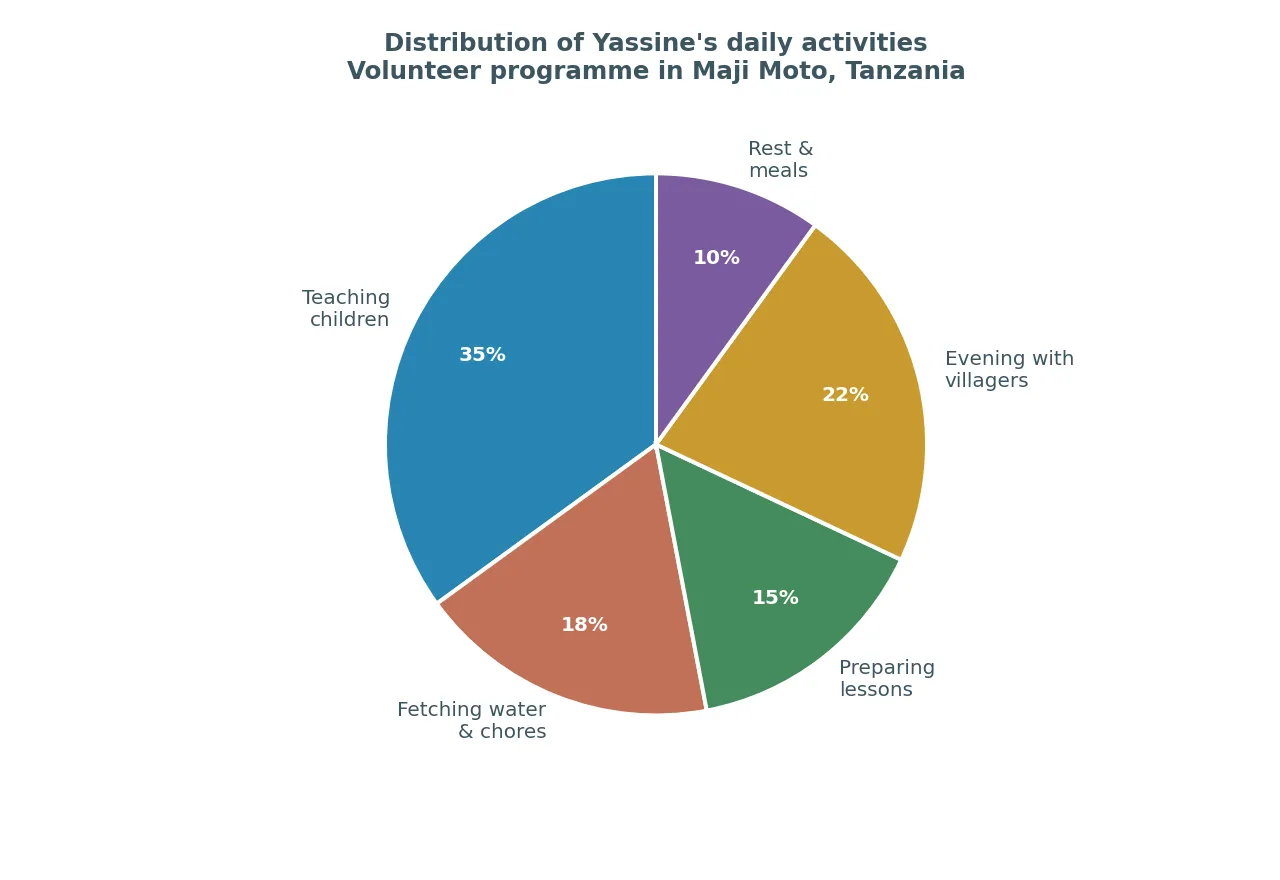
Figure 1 — Distribution of Yassine’s daily activities during his volunteer programme in Tanzania.
Part Two — Language (6 marks)
1) Fill in the blanks with words from the box. There is ONE extra word. (2.5 marks)
[ eager — homesick — courage — rewarding — fetched — patience ]
Yassine taught children who were …………… to learn. Every morning, he …………… water from a distant well. Although he sometimes felt ……………, he found the …………… to carry on. In the end, he described the experience as highly …………… .
2) Put the verbs in brackets in the correct tense or form. (2 marks)
a) When Yassine (arrive) …………… in Tanzania, he could not speak Swahili.
b) He (teach) …………… English and mathematics to primary-school children for three months.
c) If more young people (volunteer) …………… abroad, the world would be a better place.
d) Yassine said that he (return) …………… to Tanzania after graduation.
3) Circle the correct alternative. (1.5 marks)
Yassine, (who / which / whose) is now studying medicine, intends to work in a rural clinic. (Although / Despite / Because) the hardship, he found the experience rewarding. Volunteering taught him patience (as well as / along with / instead of) humility.
Part Three — Writing (6 marks)
1) Guided writing — Biography (2.5 marks)
Use the notes below to write a short biography (about 6–8 lines) of the Kenyan conservationist Wangari Maathai.
• 1940: born in Nyeri, Kenya / grew up in a rural village.
• 1964: obtained a degree in biology in the United States.
• 1971: became the first woman in East Africa to earn a PhD.
• 1977: founded the Green Belt Movement / encouraged women to plant trees.
• 2004: awarded the Nobel Peace Prize / first African woman to receive it.
• 2011: died in Nairobi / over 50 million trees had been planted thanks to her movement.
Wangari Maathai was born in Nyeri, Kenya, in 1940. …………………
2) Essay (3.5 marks)
You have just returned from a volunteer experience (in Tunisia or abroad). Write a letter to a friend in which you describe what you did, what you learned, and how the experience changed you. Sign your letter ‘Yours, [your first name].’ (Write about 10–12 lines.)
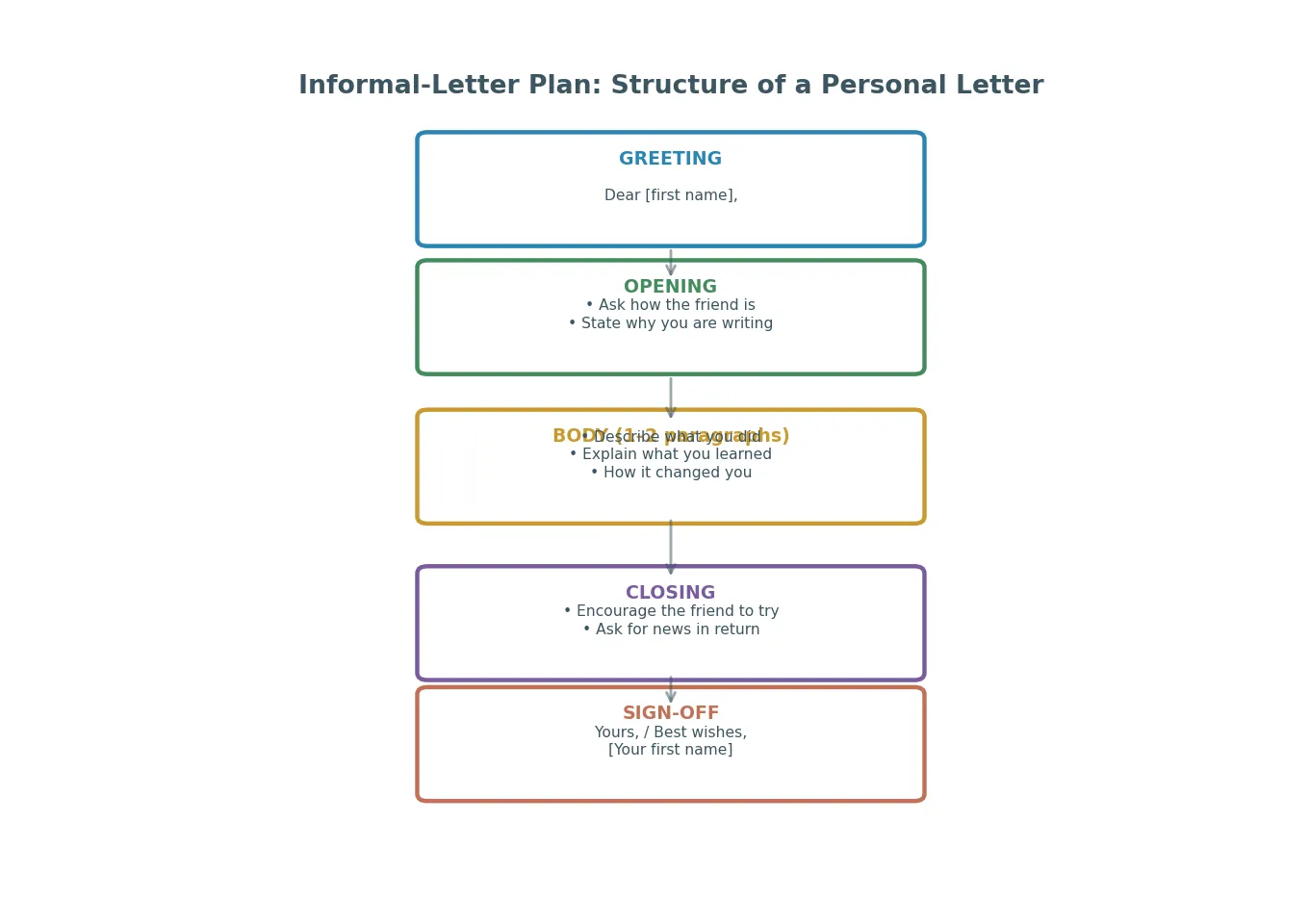
Figure 2 — Informal-letter plan: structure of a personal letter to a friend.
Tips for students and parents
For the student
Revise all first-term themes and grammar structures (tenses, conditionals, reported speech, linkers).
Always justify True/False answers with evidence from the text and spot the extra word in vocabulary boxes.
Plan essays briefly before writing and structure biographies chronologically.
For parents
Set a timed two-hour practice session with one PDF before checking the answer key together.
Check that justifications are included for every True/False statement and review the model essays.
Encourage clear paragraphs, accurate tense signals, and neat presentation.
Common mistakes to avoid
Giving a True or False answer without a justification from the text.
Confusing Past Simple and Present Perfect or using ‘despite’ before a full clause instead of a noun/gerund.
Using all words from the vocabulary box or writing an essay without a clear structure and linking words.
Download the exam PDFs
Each PDF includes the complete paper, figures, and detailed answer key. Links open in a new tab.
What are the duration and mark scheme of Devoir de synthèse n°1 in English?
The exam lasts 2 hours (coefficient 2) and is marked out of 20 across Reading Comprehension (8 pts), Language (6 pts), and Writing (6 pts).
Are figures and answer keys included?
Yes. Figures accompany the questions online, and each PDF contains the full exam together with its answer key.
What topics are covered in these three exams?
Solar electrification in rural areas, banning smartphones at school, and youth volunteering abroad, alongside core tenses, linkers, biographies, and essays.